El Niño is one of the most recognized phenomena of natural climate variability, not only for the peculiarity of its name but also for its impact on the global climate. Originally, El Niño was recognized as a local phenomenon in which recurrent anomalous warming of the normally cold Southern Hemisphere summer waters off the Peruvian coast was associated with reduced fish catches and floods in a region accustomed to bountiful catches and a coastal arid climate (Enfield, 2026). Because fishermen in northern Peru noted this phenomenon occurred around Christmas time, it was referred as El Niño in reference to the birth of the Christ Child. Through the 20th century, discoveries linking this warming of the waters with changes in atmospheric pressure, basin-wide observations of the waters in the equatorial Pacific, modeling studies, and the recurrence of the phenomenon with its associated disruption of local and remote climate, the local El Niño gained global attention. Now it is understood that the reverse situation, when the waters off the coast of Peru and along the equatorial Pacific get anomalously cold, La Niña makes its appearance with the associated disruption of local and remote climate. Consequently, monitoring sea surface temperatures (SST) in the Tropical Pacific is a primary tool for identifying how these events develop and evolve. The impact that El Niño/La Niña have on Maryland's climate can be explored on the Maryland ENSO Impact page.
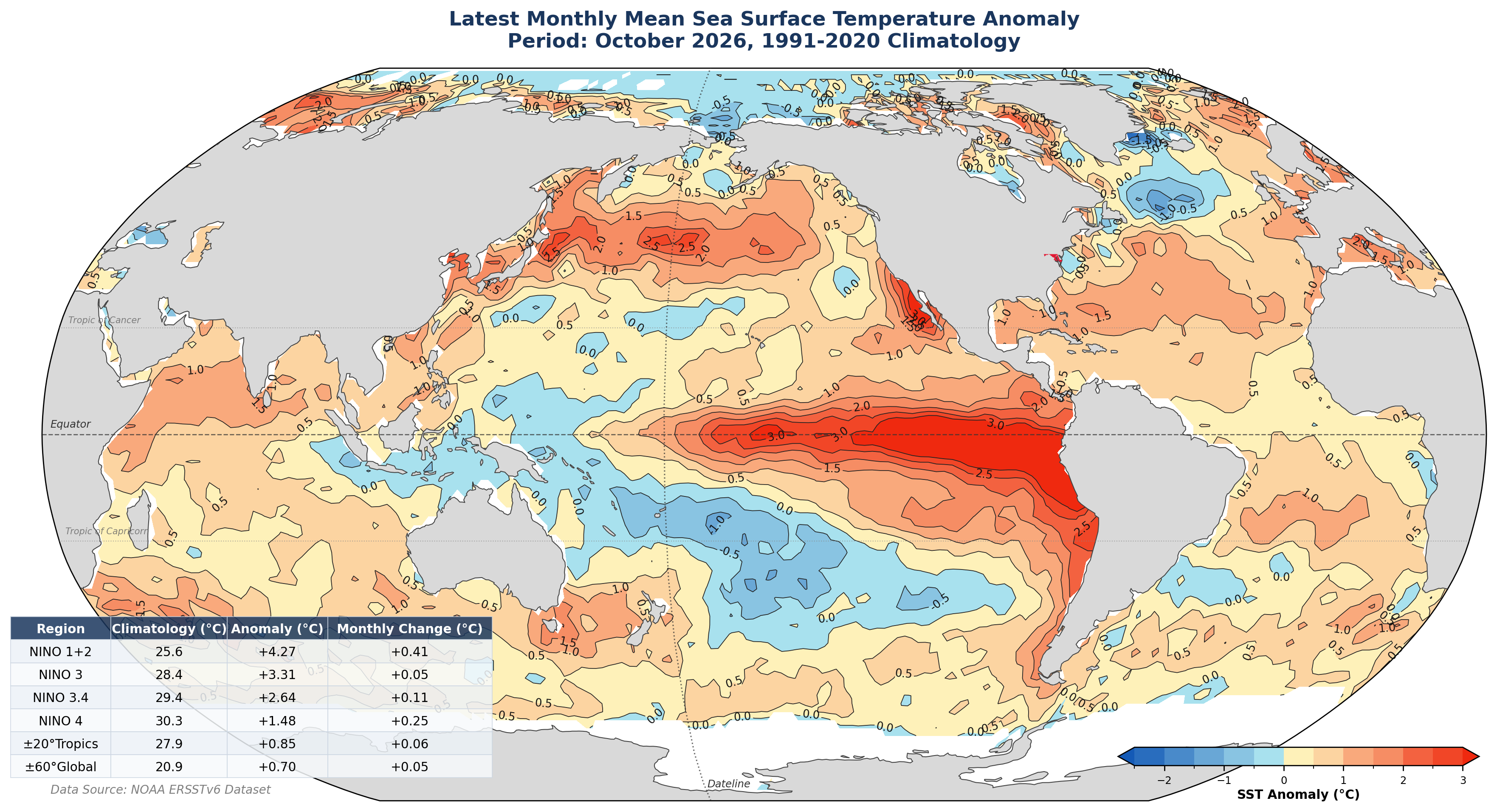
Nowadays, El Niño/La Niña is understood as a phenomenon that exists due to the interaction between the ocean and atmosphere and is also generically known as El Niño/La Niña Southern Oscillation, or ENSO; the latter referring to the East-West seesaw in atmospheric pressure over the Indo-Pacific associated with the anomalous ocean warming/cooling of El Niño/La Niña. The history and detailed descriptions of El Niño and La Niña can be further explored on the websites of NASA, NOAA, WHOI, and PBS. Traditionally, El Niño/La Niña has been tracked by monitoring the monthly and seasonal evolution of sea surface temperatures (SST) in the equatorial Pacific. The figure to the left displays the latest monthly SST departures from normal (or anomalies).
Select an aspect of ENSO to explore:
Fundamentals of ocean-atmosphere coupling, climatological normal conditions, eastern Pacific cold tongue dynamics, classification thresholds, and the Relative Oceanic Niño Index (RONI).
Understanding ENSOReal-time monitoring of seasonal sea surface temperature departures from normal and the RONI Index, historical RONI timeline (1950-present), and life cycle of ENSO events.
Monitoring & LifecyclesInteractive SST Anomaly Explorer to review composite-mean and individual El Niño and La Niña event maps, regional SST statistics, and analyze historical case years since 1950.
ENSO ExplorerInterative Explorer to review composite-mean and individual event maps showing how El Niño and La Niña episodes affect air temperature, precipitation and snowfall across Maryland.
Maryland Impacts